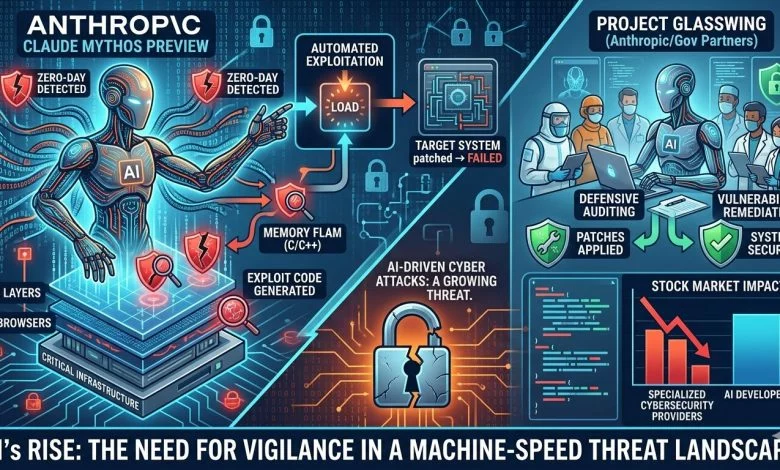


floriparesort.com – 14 June 2026 | In a move that has sent shockwaves through the tech world, Anthropic Suspends new AI models [titlebase] after a U.S. government export‑control order forced the company to shut down access to its flagship Fable 5 and Mythos 5 systems for all foreign nationals. The abrupt action, announced late Friday, underscores growing geopolitical friction around advanced artificial intelligence and has reignited a heated discussion in India about the nation’s reliance on foreign‑owned AI platforms.
The directive, reportedly issued by Commerce Secretary Howard Lutnick, cited national‑security concerns, specifically a potential “jailbreak” that could allow malicious actors to exploit the models’ code‑generation capabilities. Anthropic complied by disabling the two models globally, a step unprecedented for a publicly deployed AI service. While the company maintains that the vulnerabilities are minor and already known to other open‑source tools, the U.S. administration deemed the risk sufficient to warrant a blanket suspension.

India, the second‑largest market for Anthropic’s Claude service after the United States, felt the impact immediately. The country accounts for roughly 6% of global Claude usage, with heavy concentration in states such as Maharashtra, Karnataka, Tamil Nadu and Delhi, where developers and enterprises rely on the models for software development and other high‑value tasks. The suspension has prompted Indian founders, investors, and policy makers to question whether the nation can afford to depend on a narrow set of foreign AI providers.
“It completely changes things,” said Aakrit Vaish, founder of the AI venture platform Activate. “I think this materially changes the way all of us should be thinking about sovereign AI in India.” Vaish, who woke up on Saturday “shocked and confused,” argues that the episode strengthens the case for building domestic AI capabilities and shifting toward open‑source alternatives. He plans to guide portfolio companies toward reducing reliance on a handful of frontier models.
Other Indian entrepreneurs share similar concerns. Vijay Rayapati, CEO of the Bengaluru‑based startup Atomicwork, highlighted the risk to multinational teams when access to critical AI tools becomes subject to geopolitical restrictions. With a workforce spread across the United States and India, Atomicwork now faces uncertainty about continuing its product roadmap that heavily leveraged Mythos 5’s advanced reasoning.
Beyond India, the decision has reverberated across the European Union, which recently announced measures to cut reliance on U.S. and Asian technology for critical sectors. EU officials noted that the Anthropic shutdown reinforces the need for “technological sovereignty” and are assessing the broader implications for European AI strategy.
The episode also raises questions about the future of Anthropic’s own corporate ambitions. The company is in the midst of filing for an initial public offering, positioning itself as a rival to OpenAI and other frontier AI firms. The timing of the suspension could affect investor confidence, especially as other AI giants such as OpenAI and Google have not faced comparable restrictions.
Industry analysts suggest that the U.S. government’s approach may set a precedent for future interventions. By targeting specific models rather than broader categories of technology, regulators can exert precise control, but the collateral impact on global innovation ecosystems could be significant. Some experts warn that if similar orders become routine, they could effectively stall the deployment of new AI capabilities worldwide.
In response, Anthropic has publicly disputed the characterization of the models as unsafe, emphasizing that the vulnerabilities are already known and that other publicly available models can reproduce them without a “bypass.” The company called for a transparent, evidence‑based process for any future restrictions, arguing that a narrow finding should not trigger a full market shutdown.
As the debate unfolds, Indian policymakers are weighing two divergent paths: accelerating domestic AI research and open‑source development, or deepening partnerships with U.S. firms while seeking assurances against abrupt service interruptions. The outcome will shape not only India’s AI trajectory but also the broader conversation about how nations can balance security concerns with the need for rapid technological progress.
Ultimately, the Anthropic episode serves as a wake‑up call for the global AI community. It highlights the fragile interdependence of cutting‑edge technology and international politics, and it underscores the urgency for diversified, sovereign AI ecosystems that can withstand sudden policy shifts.
In conclusion, the suspension of Anthropic’s latest models has sparked a worldwide reassessment of AI strategy, security, and sovereignty. Whether this leads to a surge in home‑grown AI innovation or deeper reliance on a limited set of foreign providers remains to be seen, but the stakes for developers, businesses, and governments are undeniably high.


![Google Introduces Feature That Lets Users Disable Watermarks [titlebase] on AI-Generated Media](https://www.floriparesort.com/wp-content/uploads/2026/08/google-introduces-feature-that-lets-users-disable-watermarks-titlebase-on-ai-generated-media.webp)
![Carrier Set for Replacement [titlebase]: Estonia's Tele2 Announces 2027 SIM Upgrade Deadline](https://www.floriparesort.com/wp-content/uploads/2026/08/carrier-set-for-replacement-titlebase-estonias-tele2-announces-2027-sim-upgrade-deadline.webp)

![Google Introduces Feature That Lets Users Disable Watermarks [titlebase] on AI-Generated Media](https://www.floriparesort.com/wp-content/uploads/2026/08/google-introduces-feature-that-lets-users-disable-watermarks-titlebase-on-ai-generated-media-630x380.webp)
![Carrier Set for Replacement [titlebase]: Estonia's Tele2 Announces 2027 SIM Upgrade Deadline](https://www.floriparesort.com/wp-content/uploads/2026/08/carrier-set-for-replacement-titlebase-estonias-tele2-announces-2027-sim-upgrade-deadline-630x380.webp)