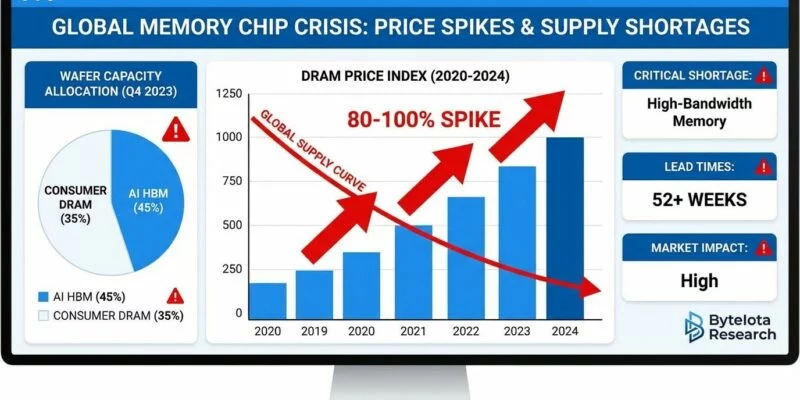


floriparesort.com – 18 June 2026 | Memory shortage hits prices [titlebase] as the global memory chip shortage continues to wreak havoc on the tech industry. Apple CEO Tim Cook has announced that the company will be raising prices on some of its products due to the increasing costs of memory and storage chips. This move comes as the AI industry’s demand for memory chips has skyrocketed, driving up costs and making it unsustainable for Apple to maintain its current pricing model.
The memory shortage hits prices [titlebase] as Apple struggles to keep up with the demand for its products while also dealing with the rising costs of components. Cook stated that “price increases are unavoidable” and that the company has been trying to shield its customers from the increases, but the situation has become unsustainable. The memory shortage hits prices [titlebase] is expected to affect not only Apple but also other tech companies that rely on memory chips for their products.

The memory shortage hits prices [titlebase] is a result of the increasing demand for memory chips from AI companies, which are building larger and more complex models that require huge amounts of memory. This has led to a surge in demand for DRAM and NAND chips, which are used in everything from smartphones to data centers. The memory shortage hits prices [titlebase] is expected to continue until 2028, according to Intel CEO Lip-Bu Tan.
Apple is not the only company affected by the memory shortage hits prices [titlebase]. Other tech companies, including Microsoft, have also increased prices as memory costs soar. The memory shortage hits prices [titlebase] is a global issue that affects not only the tech industry but also the economy as a whole. As the demand for memory chips continues to grow, it is likely that the memory shortage hits prices [titlebase] will continue to be a major issue for companies and consumers alike.
In conclusion, the memory shortage hits prices [titlebase] is a serious issue that affects the tech industry and the economy. Apple’s decision to raise prices is a result of the increasing costs of memory and storage chips, and it is likely that other companies will follow suit. As the demand for memory chips continues to grow, it is essential for companies to find ways to mitigate the effects of the memory shortage hits prices [titlebase] and to develop new technologies that can help reduce the demand for memory chips.
![EU Fines Temu $232M [titlebase]: A Landmark Decision in Tech Regulation](https://www.floriparesort.com/wp-content/uploads/2026/05/eu-fines-temu-232m-titlebase-a-landmark-decision-in-tech-regulation-60x60.webp)

![Google Introduces Feature That Lets Users Disable Watermarks [titlebase] on AI-Generated Media](https://www.floriparesort.com/wp-content/uploads/2026/08/google-introduces-feature-that-lets-users-disable-watermarks-titlebase-on-ai-generated-media-60x60.webp)
![Google Introduces Feature That Lets Users Disable Watermarks [titlebase] on AI-Generated Media](https://www.floriparesort.com/wp-content/uploads/2026/08/google-introduces-feature-that-lets-users-disable-watermarks-titlebase-on-ai-generated-media.webp)
![Carrier Set for Replacement [titlebase]: Estonia's Tele2 Announces 2027 SIM Upgrade Deadline](https://www.floriparesort.com/wp-content/uploads/2026/08/carrier-set-for-replacement-titlebase-estonias-tele2-announces-2027-sim-upgrade-deadline.webp)

![Google Introduces Feature That Lets Users Disable Watermarks [titlebase] on AI-Generated Media](https://www.floriparesort.com/wp-content/uploads/2026/08/google-introduces-feature-that-lets-users-disable-watermarks-titlebase-on-ai-generated-media-630x380.webp)
![Carrier Set for Replacement [titlebase]: Estonia's Tele2 Announces 2027 SIM Upgrade Deadline](https://www.floriparesort.com/wp-content/uploads/2026/08/carrier-set-for-replacement-titlebase-estonias-tele2-announces-2027-sim-upgrade-deadline-630x380.webp)